Today, I did not have a Garmin Coach drill workout.
No benchmark run.
No Run Walk Run session.
No structured workout from the watch.
But I still went out for a 30-minute run.
This time, I gave myself a different goal.
I wanted to focus on running form.
More specifically, I wanted to keep my cadence around 180 steps per minute and my ground contact time under 250 ms.
Before using Garmin seriously, I mostly cared about distance and pace.
How far did I run?
How fast was I?
Was my pace better than last time?
But now, I am slowly starting to look at other numbers too.
Cadence.
Ground contact time.
Stride length.
Vertical oscillation.
How my body feels while running.
Today’s run was not just a 30-minute run.
It was a small running form practice.
Today’s Goal
Today’s goal was simple.
| Focus | Target |
|---|---|
| Cadence | Around 180 spm or higher |
| Ground Contact Time | Under 250 ms |
| Run Type | 30-minute form-focused run |
| Garmin Coach Workout | None |
| Final Average Pace | 5:25/km |
I was not trying to do a hard speed workout.
I was not trying to race.
I simply wanted to see what would happen if I paid more attention to how my feet touched the ground and how quickly my legs turned over.
As a beginner runner after 40, I think this kind of practice matters.
Running is not only about pushing harder.
Sometimes, it is about moving better.
Why Cadence Matters to Me
Cadence is the number of steps I take per minute.
Many runners talk about 180 spm as a common reference point, but I do not think every runner must always hit that exact number.
For me, 180 was not a magic number.
It was a focus point.
When I try to increase cadence, I usually feel that my steps become lighter and quicker.
I do not have as much time to sink into the ground.
I become more aware of my rhythm.
Instead of reaching too far with each step, I try to keep my feet moving under my body.
That is what I wanted to practice today.
Why Ground Contact Time Matters
Ground contact time is the amount of time my foot stays on the ground during each step.
Today, I wanted to keep it under 250 ms.
I do not know if I can always do that perfectly.
But having the goal helped me focus.
When I thought about ground contact time, I tried to avoid heavy steps.
I tried to keep my feet light.
I tried to move forward instead of bouncing too much.
That changed the feeling of the run.
It made the run feel more intentional.
Even though there was no Garmin Coach drill workout today, this simple goal made the run feel structured.
What I Felt During the Run
During the run, I noticed some body signals too.
Even though I did not feel sick, my nose kept running.
I also had more saliva than usual.
After about 10 minutes, I felt a slight blocked-ear sensation, almost like what I feel when elevation changes, even though I was running on flat ground.
I did not feel pain.
I did not feel dizzy.
I did not feel like I had to stop.
But I noticed those signals.
Running after 40 is teaching me to pay attention to these small things.
Not everything needs to be overanalyzed.
But the body always gives information.
Today, I simply noticed it and kept the run controlled.
The Result
Even while focusing on cadence and ground contact time, my average pace came out to 5:25 per kilometer.
That surprised me a little.
I was not trying to chase pace directly.
I was trying to improve rhythm.
But by focusing on quicker steps and lighter ground contact, the pace naturally became faster than a very easy run.
That was interesting.
It reminded me that better form may help pace without forcing speed.
Of course, one run does not prove everything.
But today gave me a useful clue.
When I focus on how I move, the numbers can change.When I focus on how I move, the numbers can change.
Garmin Data Changed the Purpose of the Run
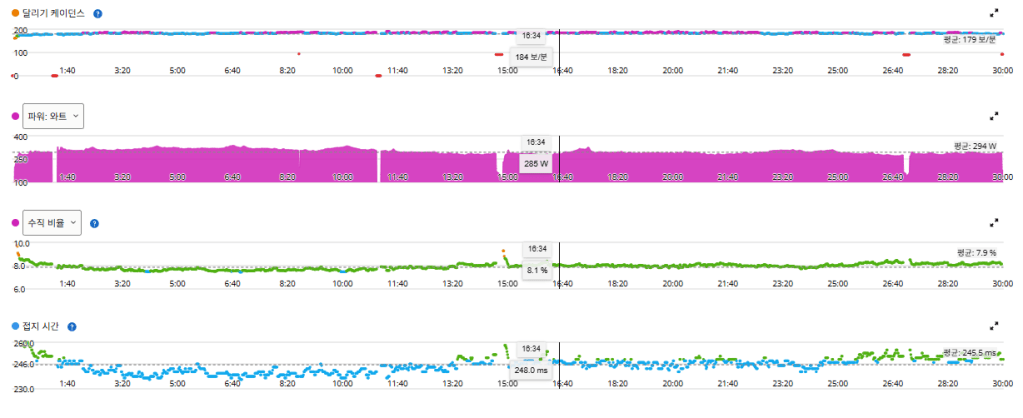
If I had run without Garmin data, I probably would have described today simply.
I ran for 30 minutes.
That would be it.
But Garmin data gave the run a different purpose.
It helped me think about questions like:
Can I keep my cadence high?
Can I reduce ground contact time?
Can I stay relaxed while doing it?
Can I run faster without forcing my body?
Can I notice body signals while still keeping rhythm?
These questions made the run more meaningful.
That is why I like using Garmin as a beginner runner after 40.
It does not make me an expert.
But it helps me observe.
Running Form After 40
Running after 40 feels different from simply running when I was younger.
Now I think more about recovery.
I think more about injury prevention.
I think more about how my body responds after the run.
So I do not want to only focus on speed.
I want to learn how to move in a way that I can repeat.
A faster pace is nice.
But consistency matters more.
And for consistency, I think form matters.
If my steps are too heavy, my body may feel more stress.
If my cadence drops too much, my rhythm may feel slower.
If my ground contact time is too long, I may feel like I am sinking into each step.
I am not saying I fully understand all of this yet.
I am still learning.
But today’s run gave me something to think about.
Why This Helps My Half Marathon Training
I am still following a Garmin Coach half marathon training journey.
Not every day is a Garmin Coach workout day.
But that does not mean non-workout days are meaningless.
Today was a good example.
There was no drill workout.
But I created my own small focus.
Cadence.
Ground contact time.
Light steps.
Controlled rhythm.
A half marathon is not only about being able to run far.
It is also about being able to move efficiently for a long time.
Today’s 30-minute run was a small practice for that.
Not a big workout.
Not a long run.
But a useful session.
My Takeaway
Today, I did not have a Garmin Coach drill workout.
But I still made the run meaningful.
I focused on keeping my cadence around 180 spm and my ground contact time under 250 ms.
I also noticed some body signals during the run, like a runny nose, more saliva, and a slight blocked-ear feeling after about 10 minutes.
Still, I kept the run controlled.
The final average pace was 5:25/km.
That made me think.
Maybe running better is not always about trying harder.
Sometimes, it is about paying attention.
Paying attention to cadence.
Paying attention to ground contact time.
Paying attention to body signals.
Paying attention to rhythm.
As a beginner runner after 40, I want to keep learning like this.
One run.
One Garmin record.
One small form goal.
One step closer to becoming a more consistent runner.
 Running After 40
Leave a comment